
From Stone to Spin
When we finally found the community press in Morocco, the pressing was about as basic as it gets, stone and metal and gravity, and the oil coming out of it was going home with the families who brought their olives in, to cook with for the rest of the year. People have been doing some version of that for about eight thousand years.
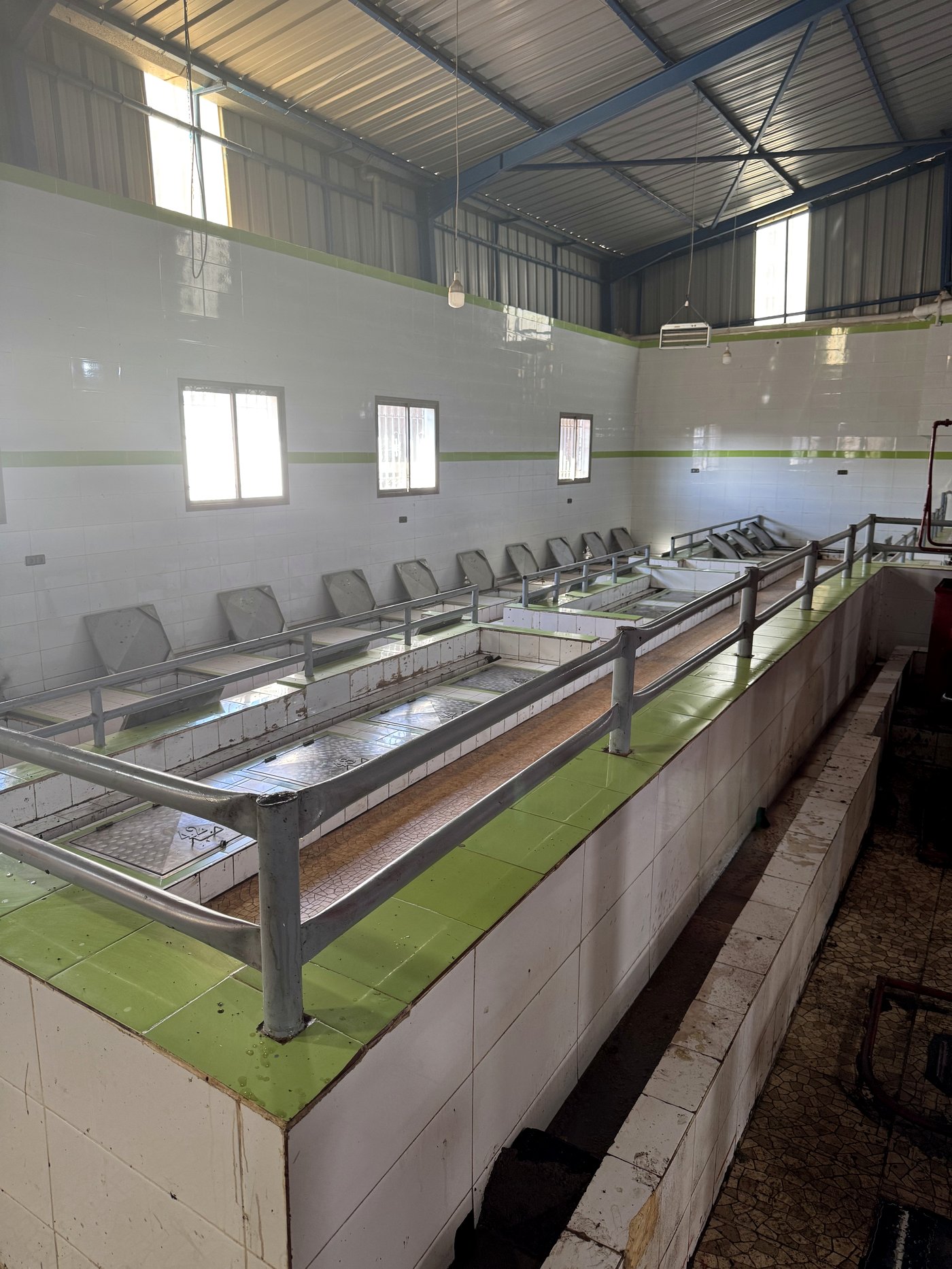
Every method, from the very first one to what's running in most mills today, has to solve the same three problems: crush the olive, get the liquid away from the solids, and get the oil away from the water. How people have done that has changed a lot over the centuries. It's also harvest season in the Northern Hemisphere right now (roughly October through December), so mills from Spain to California are running as you read this.
Feet, stones, and a lot of patience
The oldest evidence we have comes from En Zippori in the Lower Galilee, where archaeologists from the Israel Antiquities Authority and the Hebrew University of Jerusalem found olive oil residue in pottery, with two of the pieces dating to around 5800 BCE. A little later, around 5000 BCE, simple presses show up at Kfar Samir on Israel's Carmel coast.
The methods were about what you'd picture. Olives were crushed underfoot by workers in wooden sandals, or in a mortar and pestle, or under a stone roller, and then the liquid was left to sit until the oil floated up and could be ladled off the top.
The beam press
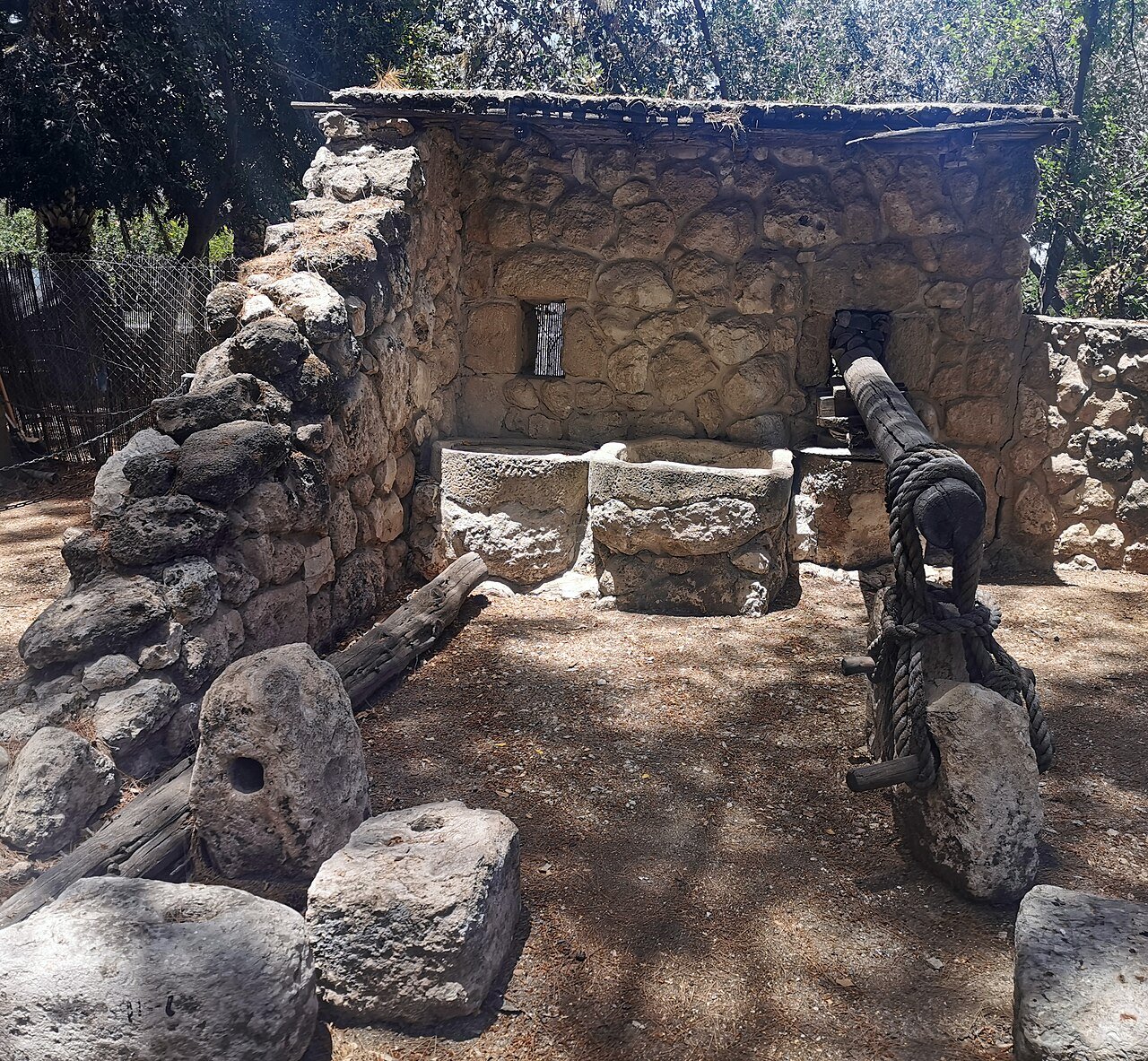
The first big upgrade was a lever. Baskets of crushed olives were stacked over a stone vat, one end of a long wooden beam was set into a niche in the wall, and heavy stones with holes bored through them were hung from the other end so the beam pressed down on the baskets. Oil and water ran into the vat and the oil rose to the top. That's the press in the photo at the top of this page, and the stones in it are the real ones from Ekron.
Ekron was a Philistine city in what's now Israel, and in the 7th century BCE it had around 115 oil installations turning out at least 500 tons of oil a year, which makes it the largest oil production center anyone has found from the ancient world. Over in the Greek world, beam presses were working at Klazomenai on the Turkish coast by the 6th century BCE, and later versions added a winch so the beam could be cranked down harder.
What the Romans added
The Romans worked on both ends of the job. To crush, they used the trapetum, a round stone basin with two half-moon millstones on a center pivot that workers or mules pushed in a circle. Cato the Elder describes one in De Agri Cultura in the 2nd century BCE, and the gap between the stones could be set so they broke up the fruit without grinding the pits to powder.
To press, they turned to the screw, which puts a lot more force into a lot less space than a beam and a pile of rocks. Hero of Alexandria wrote about building presses in his Mechanics in the 1st century CE, Pliny the Elder (writing in the same century) talks about screw presses as a fairly new improvement, and that same screw later found its way into coin minting and the printing press.
Millstones, mats, and the hydraulic press
This is the mill most of us picture when we hear "traditional." Granite millstones roll around a basin and grind the olives, pits and all, into a paste. The paste gets spread on round woven mats (fiscoli in Italian), the mats get stacked on a spindle, and a hydraulic press squeezes the stack while oil and water run down the sides.
Until the middle of the 1900s, nearly all olive oil was made this way, and it's where the language on our labels comes from. The first pressing of cool paste made the best oil. Then producers would pour hot water over what was left and press it again, and that second oil was harsher and lower in quality (some of it was burned in lamps, which is where the grade name "lampante" comes from).
Pressing on mats takes a lot of care. It runs in batches, so the paste sits out in the air while the stack is being built, and the mats are hard to get completely clean, so leftover paste from one batch can start to ferment and carry those flavors into the next. Plenty of careful millers still make lovely oil this way, they just have to stay on top of it.
Into the centrifuge
The big shift came in the early 1970s, when continuous three-phase systems started replacing the stacks of mats. In a modern mill the olives are crushed by metal hammers, discs, or blades, which is faster than stone and exposes the paste to less air. Then the paste goes through malaxation, a slow kneading in a tank that lets the tiny droplets of oil find each other and pool into bigger ones. It's gently warmed while that happens, but for extra virgin it has to stay under 27°C (80.6°F), and a lot of quality-focused millers aim for 20 to 22°C. After that the paste is spun in a horizontal centrifuge called a decanter, which separates the oil, water, and solids by weight.
The three-phase setup needs added water and leaves behind a lot of wastewater, so in the 1990s mills in Andalusia switched over to a two-phase decanter that uses little or no added water and sends the water out with the solids. It was marketed as the "ecological" system, and the University of Jaén's olive terminology project puts it at about 92% of Spain's olive oil industry today.
There's also a lesser-known method called Sinolea, or percolation, where metal blades dip into the paste and come out coated in oil, because oil clings to the metal more readily than water does. Some mills use it during malaxation to pull off oil before the paste ever gets to the decanter. Once the oil is out, most producers keep it in stainless steel tanks topped with nitrogen and held around 14 to 18°C so it doesn't oxidize before bottling.
Old way, new way
It's tempting to assume the older method makes the better oil, but the equipment matters less than everything around it: how quickly the olives get from the tree to the mill, how cool the paste stays, how much air it meets, and how clean everything is. A closed, temperature-controlled line gives a high-craft producer a lot of control over all of that, and that control is part of what you're paying for in a decorated single-estate bottle. Some producers still run stone mills, sometimes feeding into a modern decanter, because they like what stone does to the paste, and that's a real choice too.
And the community press in Morocco is doing a different job entirely, turning a family's own olives into a year's worth of cooking oil.
Reading your own bottle
"Cold pressed" on a label tells you less than it sounds like. In the EU, "first cold pressing" is only allowed on extra virgin or virgin oil made below 27°C from a first pressing in a traditional hydraulic press, and oil made below 27°C in a centrifuge or by percolation gets "cold extraction" instead. Outside the EU there aren't many rules, and since extra virgin oil has to be made cool to meet the grade anyway, the grade and the harvest date are much more useful things to look for. The harvest date especially, it'll tell you more about what's in the bottle than the extraction method ever will.
And if you can, go watch a mill run. Harvest is happening right now, and plenty of mills in Italy, Spain, Greece, and California open up to visitors during the season. Watch the decanter spin, or a stack of mats come down under a press if you can find one, and then go home and taste what came out of it.
Sources: Israel Antiquities Authority and Hebrew University of Jerusalem, En Zippori residue findings (reported 2014); Tel Miqne-Ekron Excavation Project (summary); World History Encyclopedia, "The Olive in the Ancient Mediterranean"; Pliny the Elder, Natural History; University of Jaén, Olivaterm; Olive Oil Times, "What does cold-pressed really mean?" and "How olives are processed into oil"; Commission Implementing Regulation (EU) No 29/2012, Article 5.